
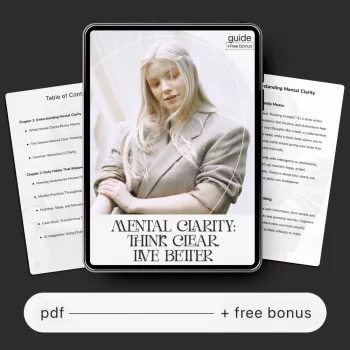
Mental clarity is the calm, steady ability to direct attention, make decisions without feeling overloaded, and return to the present when the mind wanders. When clarity is low, even simple tasks can feel heavy—often because attention is fragmented, stress is high, sleep is off, or the day has no mental “reset” points. The goal isn’t perfect concentration; it’s a repeatable system for clearing noise and strengthening focus. The digital, printable guide Mental Clarity: Think Clear, Live Better (digital printable guide) supports that system with structured exercises and routines that fit real schedules.
Mental clarity often shows up as a quieter internal experience and a more direct relationship with your next step. You start tasks faster, get pulled into fewer spirals of overthinking, and make simpler decisions without second-guessing every detail. Follow-through improves because you’re not constantly “reloading” what matters.
Common blockers are surprisingly basic: chronic stress, multitasking, poor sleep quality, dehydration, constant notifications, and unresolved mental loops (unfinished decisions, worries with no container, or too many “open tabs” in your head). If you’re curious how sleep connects to cognition and health, the NIH overview on Sleep and Health is a helpful starting point.
It also helps to separate a “busy mind” from an “unclear mind.” A busy mind can still prioritize: it knows what’s first, even if there’s a lot happening. An unclear mind struggles to choose the next right step, which creates a loop of starting, stopping, and scanning for the “best” option.
Early warning signs include rereading the same sentence, switching tasks repeatedly, irritability, and a sense of mental fog even after rest. The earlier you spot the pattern, the easier it is to reset instead of pushing harder.
Clarity improves fastest when you treat it like a system with three levers:
Use the model as a quick diagnosis. If focus feels impossible, start with body regulation. If attention keeps drifting, tighten structure. If overwhelm persists, reduce inputs until your brain can “hear itself think” again.
| What’s happening | Likely cause | Quick fix (5 minutes) | Longer fix (this week) |
|---|---|---|---|
| Can’t start tasks | Overwhelm or unclear next step | Write the next 1 action only; set a 10-minute timer | Weekly planning: 3 priorities/day, break projects into first actions |
| Mind keeps racing | Stress activation, unresolved loops | 2 minutes slow breathing + brain-dump list | Daily wind-down ritual; schedule worry/plan time |
| Constant task switching | Too many open inputs | Close tabs; silence notifications for 25 minutes | Create a “focus mode” setup and app limits |
| Foggy even when trying | Sleep debt, dehydration, low movement | Water + short walk + daylight exposure | Consistent sleep window; movement breaks 3–5x/week |
Big overhauls tend to fail on busy weeks. Micro-routines work because they’re small enough to do on low-energy days, but consistent enough to compound.
Choose a single priority, define success in one sentence, and clear the first friction point (open the file, set out materials, clear the workspace). Starting becomes easier when your environment makes the “first step” obvious.
Stand up, breathe slowly, and do a fast “what matters next” check. This interrupt prevents autopilot scrolling and helps you re-enter the afternoon with intention instead of momentum.
For a research-based overview of mindfulness and safety considerations, see the NCCIH summary on Meditation and Mindfulness: Effectiveness and Safety.
Clarity is also physical. Food choices, hydration, and movement can influence energy and attention; Harvard Health’s overview of the best brain foods offers practical direction without extremes.
The Mental Clarity: Think Clear, Live Better (digital printable guide) is a strong fit for anyone who wants guided prompts, repeatable routines, and a printable structure for focus and mindfulness habits—especially when motivation is inconsistent.
If staying consistent is the hardest part, Break Free With Smart Support (habit and routine guide) pairs well with clarity work by helping you rebuild the “default settings” of your day. And when mental fog is tied to stressful conversations or people-pleasing, Finding Courage to Speak Up (communication toolkit for stressful interactions) can reduce the background stress that quietly drains focus.
Small improvements can show up within days when sleep is more consistent, inputs are reduced, and you add one or two daily reset points. More stable clarity typically takes a few weeks of repeating simple routines until they feel automatic.
Pause, take 3 slow breaths, close extra tabs/notifications, write the next single action, set a 10–25 minute timer, and begin. Short mindfulness reps make the “return to task” skill faster over time.
Yes—mindfulness trains awareness so you catch spirals sooner and stop treating every thought as a problem to solve. It won’t erase thoughts, but combined with sleep, routines, and capture lists, it can significantly reduce the friction of overthinking.












Leave a comment