
Messing up can feel like it wipes out progress in a single moment—especially when guilt, anxiety, or rumination take over. A reset isn’t pretending it didn’t happen; it’s creating a clear path from impact to insight to next steps. With the right structure, emotional intensity drops, repair becomes possible, and momentum returns through small, repeatable actions.
An emotional reset is the shift from being flooded to being functional. It reduces emotional intensity enough to think clearly, make fewer reactive choices, and choose the next right action.
Resilience isn’t a personality trait you either have or don’t; it’s a set of skills you can build over time (see American Psychological Association guidance on resilience and NIMH tips for coping with stress).
When emotions spike, the goal isn’t to solve everything—it’s to get steady enough to avoid making the situation worse.
If you can get your nervous system down even 20%, you’ll have more access to your values and better judgment for what comes next.
Repair works best when it’s grounded and specific—neither harsh nor avoidant.
State the facts of what happened without exaggeration or minimizing. “I missed the deadline and didn’t communicate early” is clearer (and more fixable) than “I ruin everything.”
Talk to yourself like a fair coach would: firm, specific, and humane. Compassion isn’t excusing the mistake; it’s reducing the shame that blocks change.
Choose one repair step: apology, correction, replacement, a time boundary, or a plan change. Keep it small enough to do today.
Separate worth from behavior: “A mistake happened” is different from “I am the mistake.” That distinction keeps you accountable without collapsing into self-punishment.
Reflection is useful when it’s time-limited and ends with a next step. Rumination is repetitive, self-attacking, and circular. Set a timer for 10–15 minutes, write short answers, and stop when you’ve extracted one lesson and one boundary.
A simple chain to map is: situation → thought → feeling → behavior → consequence. Then look for the vulnerable moment: fatigue, people-pleasing, conflict avoidance, impulsivity, or stress stacking.
| Prompt | What to write (1–3 sentences) | Outcome |
|---|---|---|
| What exactly happened? | Stick to observable facts and timeline. | Clarity without distortion |
| What need or fear was driving me? | Name the emotion and the underlying need. | Insight into motivation |
| What did this cost me or someone else? | Be specific and measurable where possible. | Accountability |
| What is one repair step I can do in 24 hours? | Choose a realistic action, not a grand overhaul. | Momentum |
| What boundary or system would reduce repeats? | One rule, one routine, or one support change. | Prevention |
| Day | Focus | One quick action |
|---|---|---|
| 1 | Stabilize | 10-minute walk + screen break |
| 2 | Clarify | Write a 5-sentence factual recap |
| 3 | Repair | Send a concise apology or correction |
| 4 | Prevent | Create one if/then plan for the trigger |
| 5 | Practice | Rehearse the new response once |
| 6 | Rebuild | Do one values-based action (health, work, relationships) |
| 7 | Review | Choose two keepers + schedule next check-in |
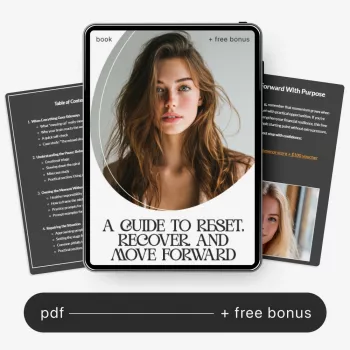
If you want a guided, repeatable structure, A Guide to Reset, Recover, and Move Forward (download) is designed for the moments when you feel stuck in shame or second-guessing. The downloadable format makes it easy to revisit prompts during repeat triggers, track what you tried, and move from emotional intensity to clear next steps.
Emotional intensity often drops within hours or a few days once you stabilize your body and stop the spiral. Deeper recovery depends on the impact, the repair steps you take, your sleep/stress load, and how consistently you follow a simple plan (like the 7-day reset).
Self-reflection is time-limited, specific, and ends with one action you can take. Rumination is repetitive and self-attacking, with no new information or next step—use a 15-minute limit and finish by choosing one repair or prevention action.
You can still take accountability, make amends where possible, and focus on behavior change that prevents repeats. If shame or anxiety feels overwhelming or persistent, professional support can help you process the event and rebuild stability.












Leave a comment